


Can Wallpaper Influence Where Your Eye Looks First in a Room?
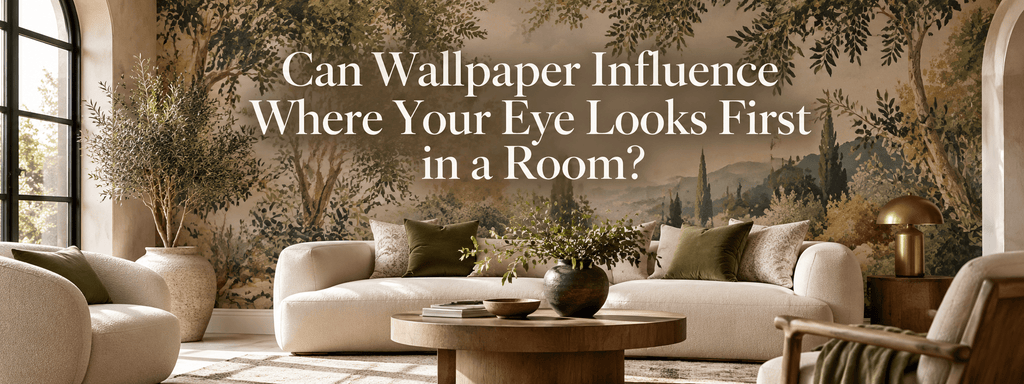
When you enter a room, your eyes do not take in everything at once.
They move.
You notice one area first, then another. Your attention may go toward a fireplace, a window, a piece of furniture, an artwork, or simply the strongest surface in the room.
What determines that first impression?
Often, it is visual hierarchy—the invisible system that tells your eyes what deserves attention and what should remain in the background.
Wallpaper can play a surprisingly important role in creating that hierarchy.
Through pattern, scale, color, contrast, texture, repetition, and placement, a wallcovering can influence where the eye lands first and how it moves through the rest of the room.
This means wallpaper is not simply something you see.
It can influence how you see the entire space.
The Eye Looks for a Starting Point
Every room contains multiple visual elements, but they rarely have equal importance.
Our eyes naturally look for areas that stand out.
A strong contrast, unusual shape, saturated color, large-scale pattern, or distinctive texture can become an immediate point of attention.
Wallpaper can intentionally create that starting point.
A dramatic wall behind a sofa can draw attention toward the seating area.
A patterned wall behind a bed can establish the bedroom's focal point.
A textured surface surrounding a fireplace can emphasize the architecture.
A carefully selected wallpaper in an entryway can immediately establish the character of the home.
The important thing is not simply making one wall noticeable.
It is deciding where you want the eye to go first.
Contrast Is One of the Strongest Attention Signals
The eye notices differences.
A dark surface surrounded by lighter elements naturally attracts attention. A strong pattern against a quiet background becomes more noticeable. A textured wall can stand out beside smooth surfaces.
This makes contrast one of the most effective tools for controlling visual hierarchy.
Imagine a room with pale furniture and natural wood flooring.
A deep green or charcoal wallpaper behind the main seating area immediately creates a visual anchor.
Now imagine the same wallpaper used in a room filled with dark furniture, patterned rugs, and dramatic artwork.
The wall may no longer have the same dominance because the surrounding environment already contains significant contrast.
Wallpaper therefore cannot be evaluated in isolation.
Its ability to attract attention depends on what surrounds it.
Color Can Tell the Eye Where to Go
Color is often one of the first things the eye registers.
This does not mean the brightest color should always be the focal point.
Sometimes a deep, saturated color creates more visual weight than a bright one.
Sometimes a subtle tonal wallpaper becomes the ideal background because it allows furniture or artwork to lead.
The key is relative importance.
A wallpaper can create hierarchy through:
-
Depth of color
-
Saturation
-
Contrast with adjacent surfaces
-
Warm or cool undertones
-
Relationship to furniture
-
Relationship to natural light
For example, a muted olive wallcovering may quietly connect with surrounding wood and greenery, while a deep burgundy pattern may become the dominant feature in the same room.
The color does not exist independently.
Its visual strength comes from its relationship with everything around it.
Pattern Creates a Path for the Eye
Pattern does more than decorate a wall.
It creates movement.
Repeated shapes give the eye a rhythm to follow. Directional elements can guide attention across a surface. Large motifs can create stopping points.
A vertical pattern can encourage the eye upward.
A horizontal composition can encourage movement across a wall.
Flowing botanical forms can guide the eye from one part of the room to another.
Geometric designs can establish a more structured visual path.
This means pattern can influence not only where the eye looks first, but also where it looks next.
A well-designed room has a visual journey.
Wallpaper can help create it.
Scale Determines How Quickly a Pattern Demands Attention
Large-scale patterns usually have a stronger immediate presence than small-scale patterns.
An oversized floral, geometric shape, or abstract composition can become recognizable from across the room.
A small repeating motif may reveal itself more gradually.
This creates two very different experiences.
Large-scale wallpaper can establish an immediate focal point.
Smaller-scale wallpaper can create atmosphere that becomes more apparent as you move closer.
Neither approach is inherently better.
The decision depends on what you want the eye to do.
If you want the wall to announce itself immediately, larger scale may be appropriate.
If you want the wall to support another focal point, a more restrained scale may be more effective.
Texture Can Attract Attention Without Being Loud
Not all focal points need strong color or dramatic pattern.
Texture can create visual interest through light.
An embossed wallpaper may appear relatively subtle when viewed straight on, but become more dimensional as light moves across the surface.
This creates a slower type of visual attraction.
The eye may initially register the overall wall, then gradually notice its depth and material detail.
This can be particularly effective in sophisticated interiors where the goal is to create richness without visual overload.
Texture gives the eye something to discover rather than something that demands immediate attention.
Wallpaper Can Frame Important Features
One of the most effective uses of wallpaper is to reinforce something that already deserves attention.
Instead of competing with architecture, wallpaper can frame it.
Consider a fireplace.
A carefully selected wallcovering behind it can strengthen its position as the room's focal point.
The same principle can work with:
-
Beds
-
Sofas
-
Dining tables
-
Consoles
-
Built-in shelving
-
Architectural niches
-
Artwork
-
Large windows
The wallpaper becomes a visual frame.
This is often more sophisticated than trying to make the wallpaper itself the only focal point.
A Focal Wall Does Not Always Need to Be the Most Dramatic Wall
There is a common assumption that the focal wall should contain the boldest possible wallpaper.
Not necessarily.
A focal point is created through difference, not simply intensity.
If the rest of the room is quiet, a moderately patterned wall may be enough.
If the room already contains strong architectural elements, a subtle textured wallpaper may actually create better hierarchy than a dramatic print.
The goal is to establish a clear visual relationship.
A focal point should feel intentional rather than forced.
Furniture and Wallpaper Work Together to Direct Attention
Furniture placement can dramatically change how wallpaper is perceived.
A wallpapered wall behind a sofa naturally directs attention toward the seating area.
A patterned wall behind a dining table reinforces the table as a central gathering point.
Wallpaper behind a bed creates a visual anchor for the sleeping area.
This relationship becomes particularly powerful when the pattern's scale and geometry complement the furniture.
For example, a strong horizontal pattern behind a long sofa can reinforce the furniture's width.
A vertical design behind a tall headboard can emphasize height.
The wall and furniture begin working as one composition.
Lighting Can Redirect the Eye
Lighting is another major component of visual hierarchy.
A wall may be visually important during the day but become less dominant at night if it is poorly illuminated.
Conversely, carefully positioned lighting can make a textured or patterned wall become the evening focal point.
Consider:
-
Wall washers
-
Sconces
-
Pendant lighting
-
Recessed lighting
-
Table lamps
-
Natural daylight
Each creates a different relationship between light and surface.
Textured wallpaper is especially responsive to directional illumination because shadows can reveal its depth.
This makes lighting an important part of wallpaper planning rather than simply a finishing detail.
The Eye Also Needs Somewhere to Rest
Creating visual hierarchy does not mean making every wall compete for attention.
In fact, the opposite is often true.
The strongest focal point becomes more effective when quieter areas surround it.
This is where negative space becomes important.
If every wall contains a dramatic pattern, every piece of furniture is sculptural, and every accessory is visually expressive, the eye loses its sense of priority.
Nothing feels particularly important because everything is asking to be noticed.
Wallpaper can therefore be used strategically.
One wall can lead.
Another can support.
The rest can allow the eye to rest.
How Pattern Density Changes Visual Priority
Pattern density refers to how much visual information occupies a given surface.
A densely patterned wallpaper naturally attracts more attention than a very open composition.
But density does not always mean complexity.
A simple motif repeated very closely can create significant visual activity.
A complicated motif with generous spacing may feel surprisingly restrained.
When deciding whether wallpaper should lead or support the room, consider not only the motif itself but how frequently it appears across the wall.
The amount of visual information matters.
Warm and Cool Colors Create Different Attention Effects
Color temperature can also influence how a wall participates in the room.
Warm colors often feel closer and more visually immediate.
Cooler tones can sometimes recede, particularly when their contrast is restrained.
But the surrounding palette matters.
A deep navy wall may become extremely dominant against pale warm furniture.
A warm terracotta wall may become the natural focal point in a room dominated by cool gray surfaces.
Again, the question is relational.
A color does not have a fixed visual priority.
Its priority changes depending on its surroundings.
Use Wallpaper to Create a Visual Sequence
The most interesting interiors often have more than one focal point—but they do not compete equally.
Instead, they create a sequence.
For example:
First: the eye notices the wallpaper behind the sofa.
Second: the pattern guides attention toward a sculptural coffee table.
Third: natural light draws the eye toward the window.
Finally: smaller decorative details become visible.
Wallpaper can participate in this sequence.
It can introduce the first visual cue and then allow the rest of the room to unfold naturally.
This creates a more immersive experience than having every element compete for immediate attention.
Different Rooms Need Different Visual Hierarchies
The ideal focal point depends on the room.
Living Room
Wallpaper can establish the seating area as the visual center while supporting artwork, architecture, or a fireplace.
Bedroom
A wall behind the bed is naturally suited to becoming a focal surface.
Dining Room
Wallpaper can emphasize the dining table and create a stronger sense of occasion.
Entryway
The wall can establish the first visual impression of the entire home.
Home Office
A wallpapered backdrop can provide visual identity without distracting from the workspace.
Powder Room
Because the space is compact, wallpaper can become an immersive focal element almost immediately.
The same wallpaper can therefore behave differently depending on where it is installed.
Common Mistakes That Disrupt Visual Hierarchy
Making Every Wall a Focal Point
If everything is dominant, nothing is dominant.
Ignoring Furniture Placement
A beautiful wallpaper can lose its intended effect if the main furniture does not relate to it.
Choosing Pattern Without Considering Scale
The pattern should relate to the room and the objects around it.
Using Too Much Contrast
High contrast can be powerful, but excessive contrast throughout the room can create visual competition.
Forgetting Lighting
A focal wall needs to remain visible under the room's actual lighting conditions.
Overdecorating the Wallpapered Wall
Sometimes the wallpaper itself is enough.
Additional artwork or accessories can weaken rather than strengthen the focal point.
A Simple Designer's Test
Before finalizing a wallpaper, stand at the entrance of the room and look at the entire space.
Ask yourself:
Where do my eyes go first?
Then ask:
Where do they go second?
And finally:
Is that the sequence I actually want?
If the answer is no, the problem may not be the wallpaper itself.
It may be the relationship between the wallpaper and everything around it.
Try changing the pattern scale, contrast, furniture placement, lighting, or surrounding decoration.
Often, small adjustments can completely change the visual hierarchy.
Final Thoughts
Wallpaper can absolutely influence where your eye looks first in a room.
Through color, contrast, pattern, scale, texture, direction, placement, and lighting, a wallcovering can establish a focal point, frame architecture, guide visual movement, and create a natural sequence of attention.
The most successful wallpaper choices do not simply ask to be noticed.
They understand when they should be noticed and how much attention they should receive.
That is what turns wallpaper into a design tool rather than simply a decorative finish.
At AdaWall, wallpaper can become part of the visual structure of an interior—helping define hierarchy, emphasize architectural features, frame furniture, and create a more intentional experience of the room.
Because sometimes great interior design is not about controlling what people see.
It is about quietly controlling where they look first.