

Can Wallpaper Define an Open-Plan Space?
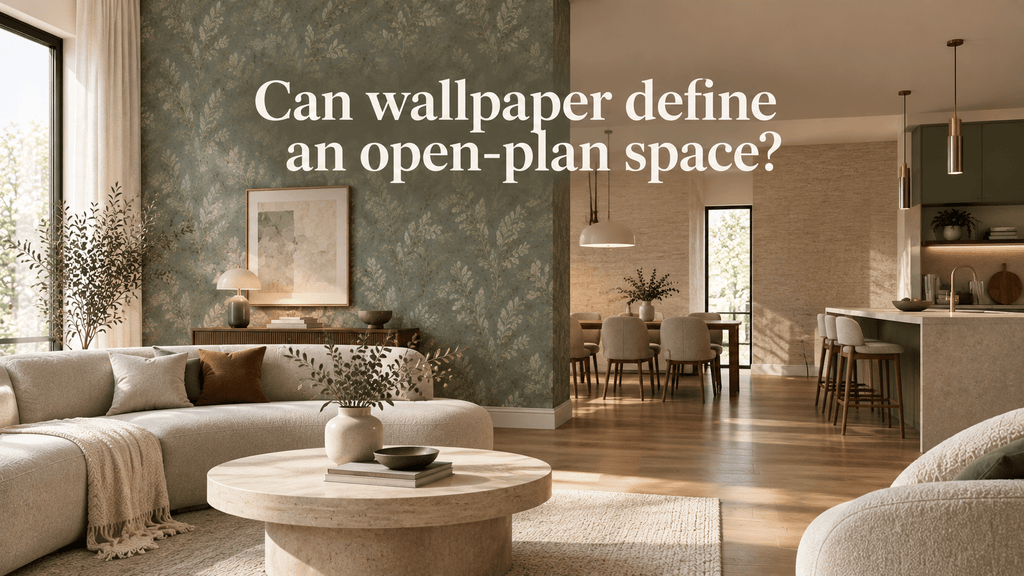
Open-plan interiors offer something many traditional layouts cannot: a sense of connection. The kitchen flows into the dining area, the dining area opens toward the living room, and multiple functions can exist within one continuous environment.
But that openness can create a design challenge.
When there are fewer physical walls, how do you make each area feel intentional without making the space feel divided?
Wallpaper can provide an answer.
Rather than using walls to separate functions, you can use color, pattern, texture, and placement to create visual boundaries. The physical layout remains open, while the design gives each area its own identity.
This approach allows wallpaper to function as more than decoration. It becomes a subtle architectural tool for organizing the way an open-plan room is experienced.
Why Open-Plan Spaces Can Feel Undefined
Open layouts are designed to connect spaces, but too much visual continuity can sometimes make different areas feel indistinguishable.
A living room, dining area, and kitchen may share:
-
The same flooring
-
The same ceiling
-
Similar furniture
-
Continuous sightlines
-
One large wall surface
-
A single lighting environment
Without some form of visual hierarchy, the entire space can begin to feel like one large undifferentiated room.
Wallpaper can introduce that missing layer of distinction.
Instead of physically closing off a dining area or home office, a carefully chosen wallcovering can signal:
This is a different zone, even though it is still part of the same space.
Wallpaper Creates a Visual Boundary Without a Physical Wall
One of the most useful qualities of wallpaper in an open-plan interior is its ability to define territory without blocking light or movement.
Imagine a dining table positioned between a kitchen and living room.
There may be no architectural wall separating the dining area.
A wallpapered wall behind the table can immediately give that area a stronger identity.
The same principle can work behind:
-
A sofa
-
A home office desk
-
A reading corner
-
A breakfast area
-
A bar
-
A fireplace
-
A media wall
The physical floor plan remains unchanged.
The visual organization becomes clearer.
Start With the Architecture
Before choosing wallpaper, look at how the open-plan space is already structured.
Look for natural boundaries such as:
-
Changes in ceiling height
-
Columns
-
Beams
-
Door openings
-
Partial walls
-
Structural projections
-
Window groupings
-
Built-in cabinetry
-
Recesses
-
Changes in floor direction
These elements can tell you where one visual zone can begin and another can end.
If you already have a natural architectural boundary, wallpaper can reinforce it rather than creating an arbitrary division.
The Anchor Wall Approach
One of the simplest ways to define an open-plan area is to create an anchor wall.
This means selecting one strategically important wall and giving it a stronger visual treatment.
For example:
Living Area
Wallpaper the wall behind the sofa.
Dining Area
Wallpaper the wall behind the dining table.
Home Office
Wallpaper the wall directly behind the desk.
The wallpaper doesn't need to cover every wall.
Its placement tells the eye where the zone begins.
This can be particularly effective when the wallpapered wall is visible from multiple parts of the open-plan space.
Use Wallpaper to Give Each Zone a Different Personality
Open-plan doesn't have to mean visually identical.
Different areas can have different personalities while still belonging to the same overall palette.
For example:
Living area: subtle textured wallpaper
Dining area: richer geometric pattern
Kitchen: restrained neutral wallcovering
The designs don't need to match.
Instead, connect them through shared characteristics such as:
-
Similar undertones
-
Related textures
-
Repeated accent colors
-
Compatible pattern scales
-
Consistent material finishes
This creates distinction without visual chaos.
Keep the Overall Palette Connected
One of the biggest risks of zoning with wallpaper is creating too much contrast.
If every zone uses a completely different color and pattern, the open-plan space can start to feel fragmented.
A more sophisticated approach is to establish a common color language.
For example:
Warm ivory + deep olive + natural oak
You could use:
-
Warm ivory textured wallpaper in the living area
-
Deep olive patterned wallpaper in the dining zone
-
Natural wood and neutral surfaces throughout
The zones feel different, but the colors still communicate with one another.
You Don't Need Multiple Wallpapers
Defining an open-plan space doesn't necessarily mean choosing a different wallpaper for every area.
One wallpaper can be enough.
For example, a single dramatic wallcovering behind the dining table can establish the dining zone while the rest of the open space remains relatively quiet.
This approach can actually create stronger visual hierarchy.
Instead of asking:
"How many wallpapers should I use?"
ask:
"Where will wallpaper have the greatest architectural impact?"
Sometimes one carefully selected wall does more than several competing patterns.
Texture Can Define a Zone Without Adding Strong Color
Not every open-plan space needs bold wallpaper.
Texture can create separation more subtly.
A linen-inspired, embossed, or dimensional wallcovering can distinguish a lounge or dining area without introducing a dramatic new color.
This works particularly well when the rest of the interior already contains:
-
Natural wood
-
Stone
-
Neutral upholstery
-
Soft lighting
-
Minimal decoration
The texture gives the zone an identity while maintaining a calm overall appearance.
Use Pattern Scale to Match the Space
Open-plan rooms are often larger than traditional rooms, which means wallpaper is frequently viewed from a greater distance.
A tiny pattern may lose its visual impact when seen from across the kitchen or living room.
A larger-scale pattern may remain recognizable from multiple viewpoints.
However, scale should be considered in relation to the architecture.
A large wall can often accommodate a larger pattern.
A narrow passage or compact corner may benefit from something more restrained.
The question isn't simply whether a pattern is large or small.
It's whether the pattern has enough visual presence for the distance from which it will be viewed.
Consider the Longest Sightline
This is one of the most useful ways to evaluate wallpaper in an open-plan home.
Don't only stand directly in front of the wall.
Stand at the opposite end of the space.
Look at the wallpaper from:
-
The kitchen
-
The dining table
-
The sofa
-
The hallway
-
The entrance
A pattern that looks beautiful from one meter away may disappear from ten meters away.
Open-plan wallpaper needs to work at multiple distances because the entire space is visually connected.
Use Color Temperature to Create Subtle Zones
Color temperature can create separation without dramatic pattern changes.
For example:
Living area: soft warm neutral
Dining area: deeper warm brown
Kitchen: lighter cream
The change in depth and temperature helps establish different zones while maintaining an overall relationship.
This can be particularly useful when you want an elegant, quiet interior rather than a highly patterned one.
Wallpaper Can Make a Dining Area Feel More Intimate
Dining areas are especially suitable for wallpaper zoning.
A dining table already creates a natural gathering point. Adding wallpaper behind it can make the area feel more intentional and intimate.
A rich botanical pattern can create a sense of enclosure.
A geometric design can reinforce a formal dining atmosphere.
A subtle textured wallpaper can provide warmth without competing with the table setting.
The physical space remains open, but the dining experience feels more distinct.
The Living Room Can Become an Architectural Anchor
In a large open-plan room, the living area can sometimes lack a clear visual center.
Wallpaper behind the sofa can establish one.
Instead of decorating the wall with numerous objects, a strong wallcovering can provide the background architecture for the seating area.
This is particularly effective when the sofa faces the wallpapered wall or when the wall is visible immediately upon entering the room.
The wallpaper establishes a destination for the eye.
What About Open Kitchens?
Kitchen areas require more consideration because they often contain a large number of materials already:
-
Cabinetry
-
Stone
-
Metal
-
Appliances
-
Wood
-
Lighting
-
Backsplashes
Wallpaper doesn't necessarily need to compete with all of them.
Instead, it can appear on an adjacent wall or dining transition where it provides visual softness.
A subtle textured wallcovering can help connect the kitchen to the living area without adding another highly active pattern.
Create Continuity Through Materials
Color isn't the only way to connect zones.
Materials can create visual continuity too.
For example:
-
Wallpaper texture can echo upholstery.
-
Wallpaper color can repeat a wood undertone.
-
A pattern accent can relate to a rug.
-
Metallic details can echo lighting fixtures.
-
Natural textures can connect the dining and living areas.
The more connections you create, the less likely the wallpaper will feel like an isolated feature.
Don't Forget the Ceiling
The ceiling is particularly important in open-plan spaces because it is usually continuous across multiple functions.
If the same ceiling extends from kitchen to living room, strong changes in wallcovering can still feel connected because the ceiling visually unifies the space.
Conversely, if the ceiling changes height between zones, that transition can become a natural location for a wallpaper change.
The relationship between wall and ceiling can help determine where one visual zone should end.
Can Wallpaper Make an Open Space Feel Smaller?
It can change the perception of scale, but that isn't necessarily negative.
A darker or more saturated wallpaper can make a specific zone feel more intimate and defined.
In an open-plan home, that can actually be useful.
For example, a deeper dining wall can make the dining area feel more enclosed without physically closing it off.
The rest of the room can remain lighter and more open.
The objective isn't always to make every part of the room feel equally expansive.
Sometimes the best design creates different spatial experiences within the same footprint.
Create Hierarchy Instead of Competition
When using wallpaper in an open-plan interior, decide which zone should receive the strongest visual emphasis.
Perhaps the dining area is the focal point.
Perhaps the living room should dominate.
Perhaps a reading nook deserves a quieter, intimate treatment.
Once you establish the hierarchy, the other zones can remain more restrained.
This prevents the entire open-plan space from becoming visually loud.
How to Choose Between One Wall and Multiple Walls
Use one wallpapered wall when:
-
You want a clear focal point.
-
The room already has plenty of visual detail.
-
You want subtle zoning.
-
The architecture provides a natural boundary.
Consider multiple wallpapered areas when:
-
The open-plan space is very large.
-
Several zones need stronger definition.
-
The wallpapers share a clear visual relationship.
-
The architecture naturally separates the areas.
If using multiple designs, keep at least one element consistent—such as color family, texture, scale, or overall mood.
Common Mistakes to Avoid
Using Completely Unrelated Wallpapers
Different zones can have different personalities, but they should still feel like parts of the same home.
Wallpapering Every Available Wall
More wallpaper doesn't necessarily create better zoning.
Ignoring Sightlines
A wallpaper that looks good from close range may not work from across the open-plan space.
Choosing Patterns Without Considering Scale
The size of the room affects how patterns are perceived.
Forgetting Existing Materials
Flooring, cabinetry, stone, and furniture already create a visual language.
Creating Too Many Focal Points
If every zone is dramatic, none of them becomes a clear focal point.
Treating the Zones as Completely Separate Rooms
The purpose of open-plan design is connection. Wallpaper should define areas without destroying that connection.
A Simple Open-Plan Wallpaper Strategy
Before selecting your wallcovering, ask:
1. What are the natural zones in the room?
Identify where people naturally cook, eat, relax, work, or gather.
2. Which zone needs more definition?
Don't automatically treat every area equally.
3. Is there a natural anchor wall?
Look behind the sofa, dining table, desk, or other focal point.
4. How will the wallpaper look from across the room?
Test it from the longest sightline.
5. What colors already connect the space?
Consider flooring, cabinetry, upholstery, metals, and textiles.
6. Do you need one wallpaper or several?
Often, one strong wallcovering is enough.
7. Does the wallpaper enhance the architecture?
The best placement usually feels intentional rather than arbitrary.
Frequently Asked Questions
Can wallpaper really define an open-plan space?
Yes. A strategically wallpapered wall can visually establish a living, dining, or work zone without requiring a physical partition.
Should I use different wallpaper in each open-plan zone?
Not necessarily. One carefully positioned wallpaper can be enough. If you use multiple designs, connect them through color, texture, or pattern relationships.
Where should wallpaper go in an open-plan living area?
Common locations include the wall behind the sofa, dining table, desk, fireplace, or another natural focal point.
Will wallpaper make an open-plan room feel smaller?
A darker or stronger wallpaper can make a specific area feel more intimate, but this can be useful for creating definition within a large open space.
How do I keep multiple wallpaper zones cohesive?
Use a shared color family, similar undertones, complementary textures, or recurring accent colors so the different areas remain visually connected.
Final Thoughts
Open-plan design doesn't mean every part of a home has to look exactly the same.
The beauty of an open layout is that spaces can remain physically connected while still developing their own identities.
Wallpaper can help create that distinction without adding walls.
It can frame a dining area, anchor a living room, define a workspace, soften a kitchen transition, or turn an overlooked corner into a purposeful part of the home.
The most successful approach isn't about using the most wallpaper.
It's about using it where it has the greatest visual and architectural impact.
When color, pattern, texture, scale, and placement work together, wallpaper can give an open-plan interior something it often lacks: definition without division.